In the 1980s, many schools had an educational climate of accepting corporal punishment. The militaristic teachers, both males and females, had resorted to cruel punishment in schools, disregarding the wishes, human rights, and feelings of children.
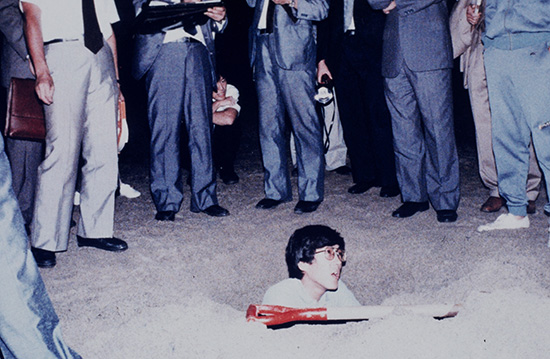
In 1989, the teachers of Iki Jr. High School, Fukuoka City, suspected and summoned two 8th graders about the blackmail case in school. The male students denied any involvement in the delinquent crime. To force a confession, seven teachers drove the students to the beach 8 km (5 miles) away from school. While the other teachers were watching, two teachers dug holes and buried the students to the neck. On the edge of the water, the teachers forced the students to make a confession. But they denied the involvement consistently. After digging out the students, three teachers beat up one of them as if he were convicted.
It was learned later that prior to this incident, the seven teachers had beaten five other students to force a confession. The eardrum of one student was broken as a result. (Asahi Newspaper, 9/12/89)
The Education Board of Fukuoka City refused to disclose the names of the teachers, saying “They overdid it out of educational passion.” The brutal punishment of the teachers seems identical to that of Japanese soldiers who had buried Chinese POWs alive during WWII.

Moeko Tawara, a journalist with Sankei Newspaper, reported in 1985 that a female teacher punished “a disobedient pupil” in cruel manners (Iwanami Booklet No. 56, p7-8, translated by the author)
As a school board member I received many complaints on corporal punishment. One case of cruel punishment remains vividly in my memory. One female teacher at an elementary school in Tokyo punished a pupil who did not finish her lunch. The teacher never permitted her students to leave leftover food, according to the school rule of “eat lunch silently, no leftovers, within specified time.”
One day, the teacher noticed the pupil did not finish her lunch. The teacher ordered the little girl to eat up. Taken by surprise, the child swallowed the food hurriedly. But she vomited the food she was taking in. The teacher said, “Eat your throw up. It is not dirty because the food came out of your mouth.” It was a horrifying scene. The little girl was eating her vomit, the teacher was standing high-armed, and all of her classmates were watching the punishment silently. The teacher’s act should be called “bullying by a teacher.” It is obvious that children will model the teacher’s bullying. But this kind of cruel punishment was accepted because a majority of teachers supported corporal punishment….
The core problem of cruel punishment lies in the fact that most teachers believe that they are doing the “right thing” for the “good of the students.” A prefectural school board official, who asked not to be identified, said:
“Society tends to glorify ‘hot-blooded’ teachers who resort to physical means in trying to keep disobedient and rebellious students in line.” He added, “More teachers think about overrate corporal punishment as the best and most effective means of educating the young.” (Asahi Evening News, 11/27/85)
Imperial Japan glorified “hot-blooded” soldiers who resorted to cruel punishment to keep Allied Prisoners of War in line.

The officers and soldiers of Imperial Army believed that brutal punishment was the best and most effective means of educating “disobedient and rebellious POWs.”

The illustration is titled “Some Japanese pastimes in punishment for minor crimes.” (The Knights of Bushido: A History of Japanese War Crimes during World War II)
1) Filling victim with water through nose, tied with barbed wire. 2) Then jumped on & kicked & beaten with square poles, 3) Tied to a tree with barbed wire, left 2 days & nights without food or water. Bucket of water in front of him. Japs accused him of threatening sentry. 4) Made to kneel on sharp sticks & hold heavy rock periods 1 to 3 hours. 5) Victim’s crime: found hear secret radio, Thailand. Tied to branch by thumbs, toes just touching ground.6) prisoner released from jail, not having seen the light of day for 3 years.
The teachers performed the role of Japanese soldiers to intimidate, torture, or kill their POWs—Japanese school children. They employed the old Imperial Japanese Army technique of corporal punishment, which resulted in countless injuries from bruises, broken bones, broken eardrums, or even to death. The teachers punished children freely, with almost no legal punishment.
Although technically illegal, a recent poll of Japanese teachers shows that 62 per cent use corporal punishment regularly, and 12 per cent admit to using punishment severe enough to cause “injury.” Another survey of university freshmen showed that, on average, they had suffered 14 cases of beatings by teachers while at school, including an average of being “punched!’ by teachers 2.8 times. Students frequently respond to such punishment by turning on the teachers. (Japanese school discipline terrorizes students, The Daily Journal, 01/31/86)
The fear of retaliation from school authority silenced most of the parents of the victims of abusive teachers. There was virtually no freedom of expression under the Controlled Education of Postwar Japan.
 Spiritual War in Japan
Leave a comment